9

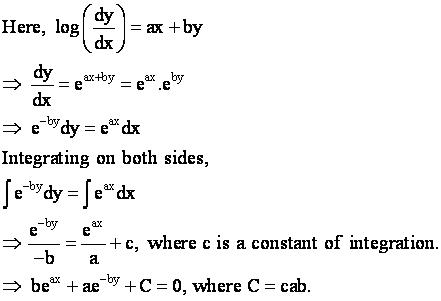
Q1. Solve the differential equation: .

Solution

Q2. Let space straight y left parenthesis straight x right parenthesis space be space the space solution space of space the space differential space equation space open parentheses straight x space log space straight x close parentheses dy over dx plus straight y equals 2 xlog space straight x left parenthesis straight x greater or equal than 1 right parenthesis
Then space straight y left parenthesis straight e right parenthesis space is space equal space to space colon
  • 1) 0
  • 2) 2e
  • 3) e
  • 4) 2

Solution

Q3. Solve the differential equation:.

Solution

The given differential equation is:

Q4. Solve the following differential equation: .

Solution

The given differential equation is:

Q5. Solve the differential equation .

Solution

Q6. Solve the differential equation .

Solution

Q7. Solve:

Solution

The given differential equation is:  

Q8. Form a differential equation of the equation: y2 + 2ay + x2 = 0.

Solution

The equation is: y2 + 2ay + x2 = 0          …(1) Differentiating w. r. to x, we get   rightwards double arrow y fraction numerator d y over denominator d x end fraction plus a fraction numerator d y over denominator d x end fraction plus x equals 0
rightwards double arrow a equals fraction numerator negative x minus y fraction numerator d y over denominator d x end fraction over denominator fraction numerator d y over denominator d x end fraction end fraction
S u b s t i t u t i n g space t h e space v a l u e space o f space a space i n space t h e space o r i g i n a l space e q u a t i o n space w e space g e t
y squared plus 2 y open parentheses fraction numerator negative x minus y fraction numerator d y over denominator d x end fraction over denominator fraction numerator d y over denominator d x end fraction end fraction close parentheses plus x squared equals 0
y squared fraction numerator d y over denominator d x end fraction minus 2 x y minus 2 y squared fraction numerator d y over denominator d x end fraction plus x squared fraction numerator d y over denominator d x end fraction equals 0
left parenthesis x squared minus y squared right parenthesis fraction numerator d y over denominator d x end fraction minus 2 x y equals 0
Q9. Solve the differential equation .

Solution

Q10. Solve the equation: .

Solution

The given differential equation is:

Q11. Show that the function f, defined by  satisfies the initial value problems y’ + y = 2, y(0) = 3.

Solution

Here, Differentiate w. r. t x, we get If we put y for f(x), then So, f satisfies the initial condition.  
Q12. Solve the differential equation

Solution

The given differential equation is:

Q13. Solve the differential equation.

Solution

The given differential equation is:

Q14. Show that is a solution of differential equation

Solution

 Here, we have the equation. Differentiate w. r. to x, we get fraction numerator d y over denominator d x end fraction equals negative a over x sin left parenthesis log x right parenthesis plus b over x cos left parenthesis log x right parenthesis
rightwards double arrow x fraction numerator d y over denominator d x end fraction equals negative a sin left parenthesis log x right parenthesis plus b cos left parenthesis log x right parenthesis
A g a i n space d i f f e r e n t i a t i n g space w. r. t space x space w e space g e t
x fraction numerator d squared y over denominator d x squared end fraction plus fraction numerator d y over denominator d x end fraction equals negative a over x cos left parenthesis log x right parenthesis minus b over x sin left parenthesis log x right parenthesis
rightwards double arrow x squared fraction numerator d squared y over denominator d x squared end fraction plus x fraction numerator d y over denominator d x end fraction equals negative left parenthesis a cos left parenthesis log x right parenthesis plus b sin left parenthesis log x right parenthesis right parenthesis
rightwards double arrow x squared fraction numerator d squared y over denominator d x squared end fraction plus x fraction numerator d y over denominator d x end fraction equals negative y
rightwards double arrow x squared fraction numerator d squared y over denominator d x squared end fraction plus x fraction numerator d y over denominator d x end fraction plus y equals 0 Which is the required differential equation
Q15. Find the order and degree of the differential equation: .

Solution

Since, the highest differential coefficient of the equation  is  and power of is one. Therefore, order of the equation is 2 and degree is 1.  
Q16. Form the differential equation of the family of curves:

Solution

The equation of the family of curves is Since, the equation (1) has two arbitrary constants a and b, so we differentiate it twice. Which is the required differential equation.
Q17. Solve the differential equation .

Solution

Q18.

Solution

The given differential equation is:

Q19. Find the solution of the differential equation:

Solution

The given differential equation is:  

Q20. Solve the equation: .

Solution

The given differential equation is:

Q21. Solve the initial value problem:

Solution

The given equation is:


Comments

Popular posts from this blog

12

Q1.   A diet is to contain atleast 10 units of vitamin A, 12 units of vitamin B and 8 units of calcium. Two foods f 1 and f 2 are available. A unit of food f 1 contains 1 unit of vitamin A, 2 units of vitamin B and 3 units of calcium and a unit of food f 2 contains 2 units of vitamin A, 2 units of vitamin B and 1 unit of calcium. If one unit of food f 1 costs Rs 16 and one unit of food f 2 costs Rs 20, find the least cost of the mixture which will produce the desired diet. Solution   Problem can be represented as           Minimise z = 16x + 20y           st x + 2y  10           2x + 2y  12 or x + y  16           3x + y  8           x  0, y  0           Corner Poi...

11

Q1. Find the angle between any two diagonals of a cube. Solution  Let O, one vertex of a cube, be the origin and three edges through O be the Co-ordinate axes. The four diagonals are OP, AA', BB' and CC'. Let 'a' be the length of each edge. Then the co-ordinates of P, A, A' are (a, a, a), (a, 0, 0), (0, a, a).             The direction ratios of OP are a, a, a.             The direction cosines of OP are  .             Similarly, direction cosines of AA' are  .             Let be the angle between the diagonals OP and AA'. Then                                      ...