Q1. A diet is to contain atleast 10 units of vitamin A, 12 units of vitamin B and 8 units of calcium. Two foods f1 and f2 are available. A unit of food f1 contains 1 unit of vitamin A, 2 units of vitamin B and 3 units of calcium and a unit of food f2 contains 2 units of vitamin A, 2 units of vitamin B and 1 unit of calcium. If one unit of food f1 costs Rs 16 and one unit of food f2 costs Rs 20, find the least cost of the mixture which will produce the desired diet.
Solution
Problem can be represented as Minimise z = 16x + 20y st x + 2y  10 2x + 2y 12 or x + y 16 3x + y 8 x 0, y 0
 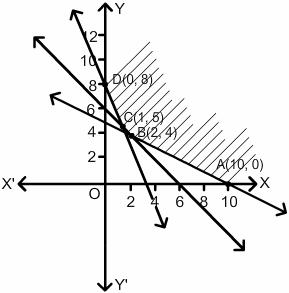 Corner Points
Z = 16x + 20y
A(10, 0) B(2, 4) C(1, 5) D(0, 8)
Z = 160 z = 32 + 80 = 112 z = 16 + 100 = 116 z = 0 + 160 = 160
Since the lowest cost in the second column is Rs.112, the minimum cost occurs at B(2,4)
Thus, the desired diet consists of 2 units of food 1 and 4 units of food 2.
Corner Points
Z = 16x + 20y
A(10, 0) B(2, 4) C(1, 5) D(0, 8)
Z = 160 z = 32 + 80 = 112 z = 16 + 100 = 116 z = 0 + 160 = 160
Since the lowest cost in the second column is Rs.112, the minimum cost occurs at B(2,4)
Thus, the desired diet consists of 2 units of food 1 and 4 units of food 2.
10 2x + 2y 12 or x + y 16 3x + y 8 x 0, y 0
Corner Points
Z = 16x + 20y
A(10, 0) B(2, 4) C(1, 5) D(0, 8)
Z = 160 z = 32 + 80 = 112 z = 16 + 100 = 116 z = 0 + 160 = 160
Since the lowest cost in the second column is Rs.112, the minimum cost occurs at B(2,4)
Thus, the desired diet consists of 2 units of food 1 and 4 units of food 2.
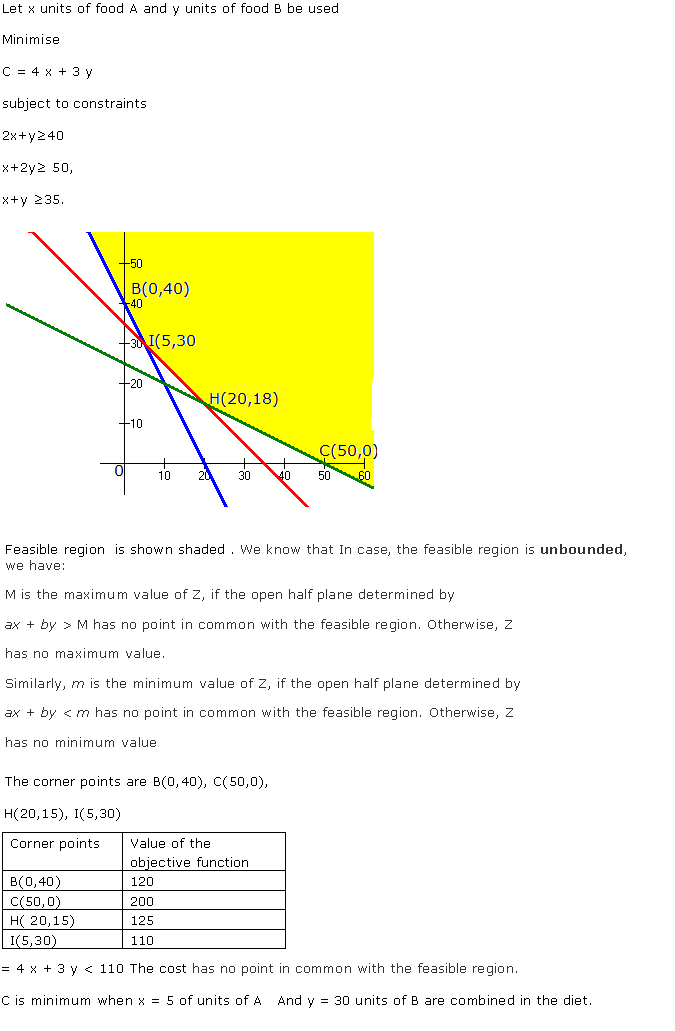
Q2. A dietician wishes to mix low calorie foods A and B in a way that, the foods contain atleast 40 units of vitamins , 50 units of minerals and 35 calories . Two foods A and B are available at a cost of Rs 4 and Rs 3 per unit respectively. One unit of food A contains 2 units of vitamins , one unit of minerals and 1 calories . One unit of food B contains 1 unit of vitamins , 2 units of minerals and 1 calories. Find what combination of A and B should be used to have least cost but satisfying all requirements
Solution
Q3. 
Solution

Q4. One kind of cake requires 200 g of flour and 25 g of fat and another kind of cake requires 100 g of flour and 50 g of fat find the maximum number of cakes which can be made from 5 kg of flour and 1 kg of fat assuming that there is no shortage of other ingredients, used in making cakes.
Solution
Let x be the number of cakes of first kind and y of other kind, then we have following LPP Maximize x + y st 200x + 100y  5000 or 2x + y 50 25x + 50y 1000 or x + 2y 40 x,y
  0
0 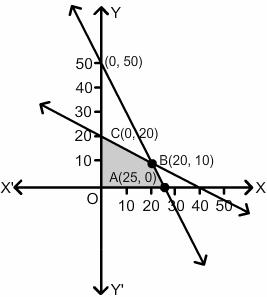 Corner Points
z = x + y
A(25, 0) B(20, 10) C(0, 20)
z = 25 z = 30 z = 20
Since the highest number of cakes in the second column of the above table is Z=30, the maximum occurs at B(20,10)
Thus, the number of first kind of cake is 20 and the number of second kind of cake is 10.
Corner Points
z = x + y
A(25, 0) B(20, 10) C(0, 20)
z = 25 z = 30 z = 20
Since the highest number of cakes in the second column of the above table is Z=30, the maximum occurs at B(20,10)
Thus, the number of first kind of cake is 20 and the number of second kind of cake is 10.
5000 or 2x + y 50 25x + 50y 1000 or x + 2y 40 x,y 0
Corner Points
z = x + y
A(25, 0) B(20, 10) C(0, 20)
z = 25 z = 30 z = 20
Since the highest number of cakes in the second column of the above table is Z=30, the maximum occurs at B(20,10)
Thus, the number of first kind of cake is 20 and the number of second kind of cake is 10.
Q5. A company manufactures two articles A and B. There are two departments I and II through which these articles are processed. The maximum capacity of department I is 60 hours a week and that of department II is 48 hours a week. The production of each article A requires 4 hours by department I and 2 hours by department II and that of each unit of B requires 2 hours in department I and 4 hours in department II. If the profit of Rs 60 for each unit of A Rs 80 for each unit of B find the number of units of A and B to be produced per week to have maximum profit.
Solution
If x units of article A and y units of articles B are produced every week, then we have following LPP maximum z = 60x + 80y st 4x + 2y  60 2x + 4y 48 x
  0, y 0 Problem can be rewritten as Maximum z = 60x + 80y st 2x + y 30 x + 2y 24 If x 0, y 0
 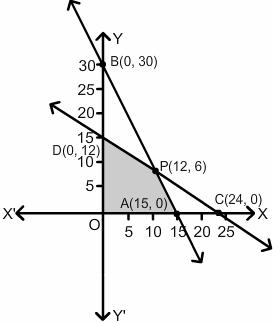 Points
Z = 60x + 80y
O(0, 0) A(15, 0) P(12, 6) D(0, 12)
0 900 1200 960
Since 1200 is highest in the second column, Maximum profit occurs at P(12,6)
Hence the number of units of article A produced is 12 and number of units of article B produced is 6 to get a maximum profit of Rs.1200.
Points
Z = 60x + 80y
O(0, 0) A(15, 0) P(12, 6) D(0, 12)
0 900 1200 960
Since 1200 is highest in the second column, Maximum profit occurs at P(12,6)
Hence the number of units of article A produced is 12 and number of units of article B produced is 6 to get a maximum profit of Rs.1200.
60 2x + 4y 48 x 0, y 0 Problem can be rewritten as Maximum z = 60x + 80y st 2x + y 30 x + 2y 24 If x 0, y 0
Points
Z = 60x + 80y
O(0, 0) A(15, 0) P(12, 6) D(0, 12)
0 900 1200 960
Since 1200 is highest in the second column, Maximum profit occurs at P(12,6)
Hence the number of units of article A produced is 12 and number of units of article B produced is 6 to get a maximum profit of Rs.1200.
Q6. A dealer deals in two items decorative plant and lamp shade. He has 10000 to invest and a space to store atmost 60 pieces. A decorative plant costs him Rs 500 and lamp shade costs him Rs 100. He can sell a decorative plant at Rs 550 and a lamp shade at Rs 115. Assuming he can sell all the items, find his maximum profit.
Solution
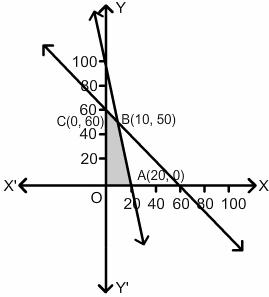
Let x decorative plants and y lamp shade are bought by the dealer. Profit on decorative plant = Rs 550 - Rs 500 = Rs 50 Profit on lamp shade = Rs 115 - Rs 100 = Rs 15 So, total profit z = 50x + 15y, we have, the following problem Maximum z = 50x + 15y st x + y  60 500x + 100y 10000 or 5x + y 100 x
  0, y 0
  Corner Points
z = 50x + 15y
0(0, 0) A(20, 0) B(10, 50) C(0, 60)
z = 0 z = 1000 z = 1250 z = 900
So, dealer can have maximum profit of Rs 1250 when 10 decorative plants and 50 lamp shades are sold.
Corner Points
z = 50x + 15y
0(0, 0) A(20, 0) B(10, 50) C(0, 60)
z = 0 z = 1000 z = 1250 z = 900
So, dealer can have maximum profit of Rs 1250 when 10 decorative plants and 50 lamp shades are sold.
60 500x + 100y 10000 or 5x + y 100 x 0, y 0
Corner Points
z = 50x + 15y
0(0, 0) A(20, 0) B(10, 50) C(0, 60)
z = 0 z = 1000 z = 1250 z = 900
So, dealer can have maximum profit of Rs 1250 when 10 decorative plants and 50 lamp shades are sold.
Q7. A pharmaceutical company manufactures two types of drugs, A and B. The combined production of the packets of the two drugs should not exceed 900 per week and the demand for packets of drug of type B is at most half of that for packets of drug of type A. Further, the production level of drugs of type A can exceed three times the production of drugs of other type by at most 500 units. If the company makes profit of Rs 10 and Rs 15 per packet of drug respectively on type A and B, how many of each should beproduced weekly in order to maximise the profit?
Solution

Q8. A fruit grower can use two types of fertilizer in his garden, brand P and brand Q. The amounts (in kg) of nitrogen, phosphoric acid, potash, and chlorine in a bag of each brand are given in the table. Tests indicate that the garden needs at least 240 kg of phosphoric acid, at least 270 kg of potash and at most 310 kg of chlorine. If the grower wants to minimise the amount of nitrogen added to the garden, how many bags of each brand should be used? What is the minimum amount of nitrogen added in the garden?
Solution

Q9. A calculator company produces a scientific calculator and a standard calculator. Long-term projections indicate an expected demand of at least 100 scientific and 80 standard calculators each day. Because of limitations on production capacity, no more than 200 scientific and 170 standard calculators can be made daily. To satisfy a shipping contract, a total of at least 200 calculators much be shipped each day.
If each scientific calculator sold results in a Rs 2 loss, but each standard calculator produces a Rs 5 profit, how many of each type should be made daily to maximize net profits?
Solution
The question asks for the optimal number of calculators, so the variables will stand for that:
x: number of scientific calculators produced y: number of standard calculators produced
Since they can't produce negative numbers of calculators, the two constraints are x > 0 and y > 0.
But in this case, constraints can be neglected as we have x > 100 and y > 80.
Also from the give data we can conclude that x < 200 and y < 170.
The minimum shipping requirement is x + y > 200.
The revenue relation will be the optimization equation: R = -2x + 5y. So the entire system is:
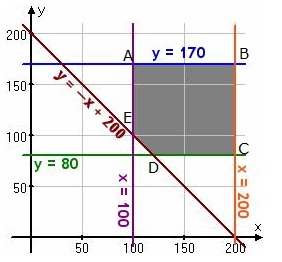
R = -2x + 5y, subject to: 100 < x < 200 80 < y < 170 x + y > 200
The feasible region is shaded in the following graph:
 Corner Points
z = -2x + 5y
A(100, 170)B(200, 170)C(200, 80)D(120,80)E(100, 100)
z = 650z = 450z = 0z = 160z = 300
While testing the corner points at A(100, 170), B(200, 170), C(200, 80), D(120, 80), and E(100, 100), the maximum value of R = 650 is obtained at (x, y) = A(100, 170).
That is, the solution is "100 scientific calculators and 170 standard calculators".
Corner Points
z = -2x + 5y
A(100, 170)B(200, 170)C(200, 80)D(120,80)E(100, 100)
z = 650z = 450z = 0z = 160z = 300
While testing the corner points at A(100, 170), B(200, 170), C(200, 80), D(120, 80), and E(100, 100), the maximum value of R = 650 is obtained at (x, y) = A(100, 170).
That is, the solution is "100 scientific calculators and 170 standard calculators".
Corner Points
z = -2x + 5y
A(100, 170)B(200, 170)C(200, 80)D(120,80)E(100, 100)
z = 650z = 450z = 0z = 160z = 300
While testing the corner points at A(100, 170), B(200, 170), C(200, 80), D(120, 80), and E(100, 100), the maximum value of R = 650 is obtained at (x, y) = A(100, 170).
That is, the solution is "100 scientific calculators and 170 standard calculators".
Comments
Post a Comment