Q1. Find the angle between any two diagonals of a cube.
Solution
Let O, one vertex of a cube, be the origin and three edges through O be the
Co-ordinate axes. The four diagonals are OP, AA', BB' and CC'. Let 'a' be the length of
each edge. Then the co-ordinates of P, A, A' are (a, a, a), (a, 0, 0), (0, a, a).
The direction ratios of OP are a, a, a.
The direction cosines of OP are  .
Similarly, direction cosines of AA' are
.
Similarly, direction cosines of AA' are  .
Let
.
Let  be the angle between the diagonals OP and AA'. Then

 .
Thus the angle between any two diagonals of a cube is
.
Thus the angle between any two diagonals of a cube is  .
.
.
Similarly, direction cosines of AA' are .
Let be the angle between the diagonals OP and AA'. Then
.
Thus the angle between any two diagonals of a cube is .
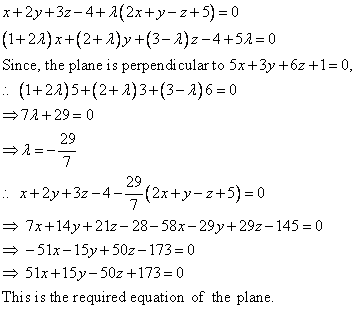
Q2. Find the equation of the plane through the intersection of the plane  ,
,  and perpendicular to the plane
  .
.
, and perpendicular to the plane .Solution
The equation of the required plane is:
Q3. Find the co-ordinates of the foot of the perpendicular drawn from the origin to the plane 2x – 3y + 6z + 7 = 0.
Solution
Let the co-ordinates of the foot of the perpendicular drawn from the origin to the plane 2x – 3y + 6z + 7 = 0 is (x1, y1, z1).
Now, the equation in the normal form is:
 Substituting these in the equation of the plane, we get
 Hence, the foot of the perpendicular is
Substituting these in the equation of the plane, we get
Hence, the foot of the perpendicular is
Q4. Find the equation of the plane passing through the line of intersection of the planes 3x – 5y + 4z + 11 = 0, 2x – 7y + 4z – 3 = 0 and the point (– 2, 1, 3).
Solution
The equation of the plane passing through the line of intersection of the planes 3x – 5y + 4z + 11 = 0, 2x – 7y + 4z – 3 = 0 is:
 .
Also, the plane passing through the point (– 2, 1, 3),
.
Also, the plane passing through the point (– 2, 1, 3),
 Now, the required equation of the plane is:

.
Also, the plane passing through the point (– 2, 1, 3),
Now, the required equation of the plane is:
Q5. Find the equation of the line in vector and in Cartesian form that passes through the point with position vector  and is in the direction
  .
.
and is in the direction .Solution
The vector form of the equation passes through and parallel to the vector is:
is:  .
The Cartesian form of this equation is:
.
The Cartesian form of this equation is:  .
.
and parallel to the vectoris: .
The Cartesian form of this equation is: .
Q6. Find the equation of the plane passing through the points (2, 5, – 8) and perpendicular to each one of the planes 2x – 3y + 4z + 1 = 0 and 4x + y – 2z + 6 = 0.
Solution
Equation of the plane passing through the point (2, 5, – 8) is:
a(x – 2) + b(y – 5) + c(z + 8) = 0 …(1)
If the plane perpendicular to the plane 2x – 3y + 4z + 1 = 0, then
2a – 3b + 4c = 0 …(2) and
If the plane perpendicular to the plane 4x + y – 2z + 6 = 0, then
4a + b – 2c = 0 …(3)
On solving equations (2) and (3), we get
 On substituting the proportional values of a, b and c in (1), we get
(x – 2) + 10(y – 5) + 7(z + 8) = 0
On substituting the proportional values of a, b and c in (1), we get
(x – 2) + 10(y – 5) + 7(z + 8) = 0

On substituting the proportional values of a, b and c in (1), we get
(x – 2) + 10(y – 5) + 7(z + 8) = 0
Q7. Find the direction cosines of the line segment joining the points (2, 0, 1) and (–1, 3, –2).
Solution
The direction ratios of the line segment joining the points (2, 0, 1) and (–1, 3, –2) are (– 1 – 2), (3 – 0), (– 2 – 1) i.e., –3, 3, –3.

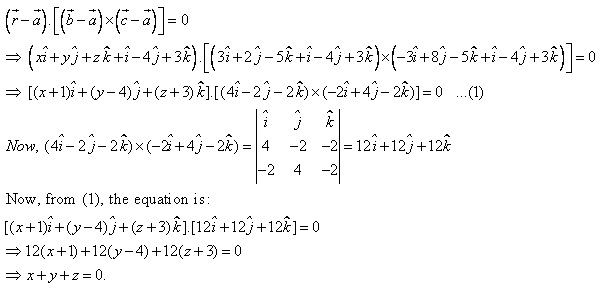
Q8. Find the equation of the plane passing through the points (–1, 4, – 3), (3, 2, – 5) and (– 3, 8, – 5).
Solution
Let  .
The equation of the plane is:
.
The equation of the plane is:
.
The equation of the plane is:
Q9. Show that the points A (2, 3, - 4), B (1, - 2, 3) and C (3, 8, - 11) are collinear.
Solution
Direction ratios of line joining A and B are 1 – 2, – 2 – 3, 3 + 4 i.e., – 1, – 5, 7.
The direction ratios of line joining B and C are 3 –1, 8 + 2, – 11 – 3, i.e., 2, 10, – 14.
It is clear that direction ratios of AB and BC are proportional, hence, AB is parallel
to BC.
But point B is common to both AB and BC. Therefore, A, B, C are collinear points.
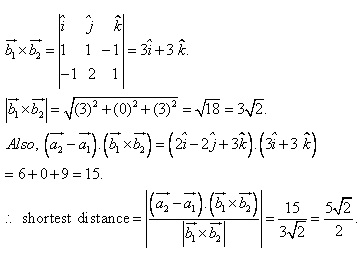
Q10. Find the shortest distance between the lines:  and
and  .
.
and .Solution
The given equations can be written as


Q11. If a line makes angles  with OX, OY and OZ respectively. Prove that
  .
.
with OX, OY and OZ respectively. Prove that .Solution
Let  be the direction cosines of the given line. Then
 .
.
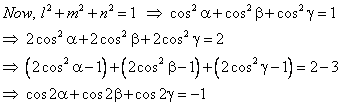
be the direction cosines of the given line. Then
.
Q12. Find the Cartesian equation of line which passes through the points (2, 0, 5) and (4, – 3, – 2).
Solution
Cartesian equation of line passing through the points (2, 0, 5) and (4, – 3, – 2) is:

Q13. 
Solution
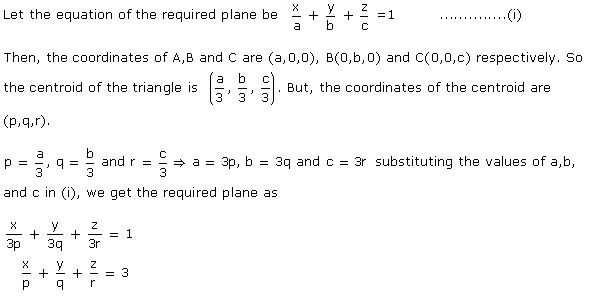
Q14. The foot of the perpendicular drawn from the origin to a plane is (2, 1, 5). Find the equation of the plane.
Solution
Since, the foot of the perpendicular to the plane is A(2, 1, 5). Therefore, (2, 1, 5) is the point on the plane.
So, equation of the plane passing through the point (2,.1, 5) is:
a(x – 2) + b(y – 1) + c(z – 5) = 0.
Now, the direction ratios of the perpendicular line OA = 2 – 0, 1 – 0, 5 – 0, i.e., 2, 1, 5.
Therefore, the required plane is:
2(x – 2) + 1(y – 1) + 5(z – 5) = 0
i.e, 2x + y + 5z = 30.
Q15. Find the equation of the plane which passes through the point (3,4,-1) and is parallel to the plane 2x - 3y + 5z + 7 = 0. Also find the distance between the two planes.
Solution
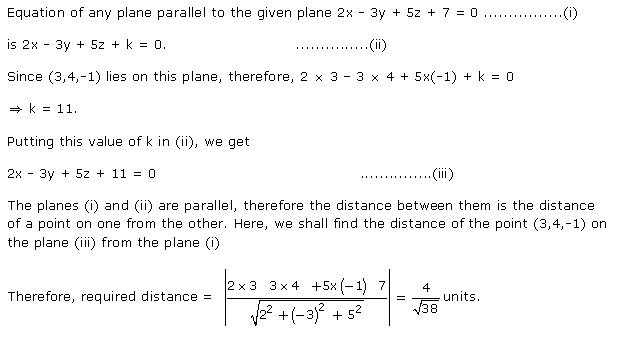
Q16. Show that the lines  and
and  are coplanar.
and are coplanar.Solution
Here, x1 = 1, y1 = – 2, z1 = – 5, a1 = 1, b1 = – 2, c1 = – 5 and
x2 = 3, y2 = – 1, z2 = – 5, a2 = 3, b2 = – 1, c2 = – 5.
 Therefore, the lines are coplanar.
Therefore, the lines are coplanar.
Q17. If a line makes angles  with OX, OY and OZ respectively. Prove that
  .
.
with OX, OY and OZ respectively. Prove that .Solution
Let  be the direction cosines of the given line. Then
 .
.

be the direction cosines of the given line. Then
.
Q18. Find the Cartesian equation of the line which passes through the origin and parallel to the line  .
.
.Solution
The direction ratios of the line, which parallel to the lineis (– 1, – 2, 5).
The Cartesian equation of the line which passes through the origin and parallel to the line is  .
.
is (– 1, – 2, 5).
The Cartesian equation of the line which passes through the origin and parallel to the line is .
Q19. Find the shortest distance between the lines:  and
and  .
.
and .Solution
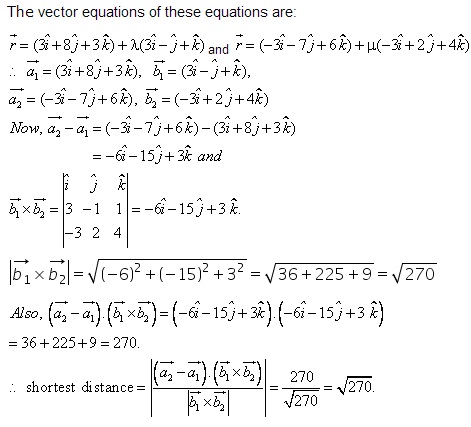
Q20. The vertices of a triangle ABC are A (–1, 2, –3), B (5, 0, –6) and
C (0, 4, –1). Find the direction cosines of the bisector of the angle BAC.
Solution
Here, AB = .
AC =
.
AC =  .
By geometry, the bisector of
.
By geometry, the bisector of  will divide the side BC in the ratio AB : AC i.e., in
the ratio 7 : 3 internally. Let the bisector of meets the side BC at point D.
Therefore, D divides BC in the ratio 7 : 3.
Coordinates of D are
will divide the side BC in the ratio AB : AC i.e., in
the ratio 7 : 3 internally. Let the bisector of meets the side BC at point D.
Therefore, D divides BC in the ratio 7 : 3.
Coordinates of D are  i.e.,
i.e.,  .
Therefore, direction ratios of the bisector AD are
.
Therefore, direction ratios of the bisector AD are .
Hence, direction cosines of the bisector AD are
.
Hence, direction cosines of the bisector AD are
 ,
,  ,
, i.e.,
i.e., .
.
.
AC = .
By geometry, the bisector of will divide the side BC in the ratio AB : AC i.e., in
the ratio 7 : 3 internally. Let the bisector of meets the side BC at point D.
Therefore, D divides BC in the ratio 7 : 3.
Coordinates of D are i.e., .
Therefore, direction ratios of the bisector AD are.
Hence, direction cosines of the bisector AD are
, , i.e.,.
Q21. Find the angle between the line  and the plane 5x – 4y + 7z + 10 = 0.
and the plane 5x – 4y + 7z + 10 = 0.Solution
Let  be the angle between the given line and the plane. The vector equations of the line and plane are:
  and
and .
Here,
.
Here,  and
and .
Now, angle between the line and the plane is given by
.
Now, angle between the line and the plane is given by

be the angle between the given line and the plane. The vector equations of the line and plane are: and.
Here, and.
Now, angle between the line and the plane is given by
Q22. A variable plane is at a constant distance p from the origin and meets the axes in points A,B,C. Through A,B, C planes are drawn parallel to the coordinate planes. Prove that the locus of their point of intersection is x-2 + y-2+z-2 = p-2.
Solution
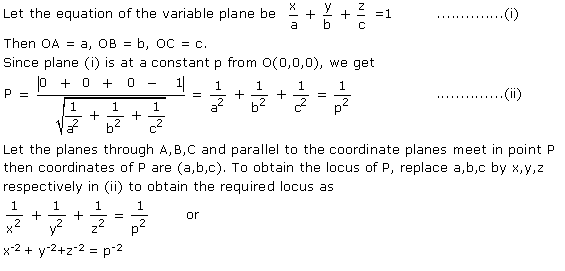
Q23. Show that the lines  and
and  are perpendicular.
and are perpendicular.Solution
The direction ratios of the first line are 3, – 2, 5 and the direction ratios of the second line are 1, – 1, -1. If the angle between the lines is , then
 Thus, the lines are perpendicular.
, then
Thus, the lines are perpendicular.
Q24. Find the distance of the point (3, – 2, 5) from the plane  .
.
.Solution
Here,  ,
,  and d = 5.
Now, the distance of the point (3, – 2, 5) from the plane is:
and d = 5.
Now, the distance of the point (3, – 2, 5) from the plane is:

, and d = 5.
Now, the distance of the point (3, – 2, 5) from the plane is:
Comments
Post a Comment