Q1. Find the area of the region bounded by the curves x2 + y2 = 2 and x = y2.
Solution
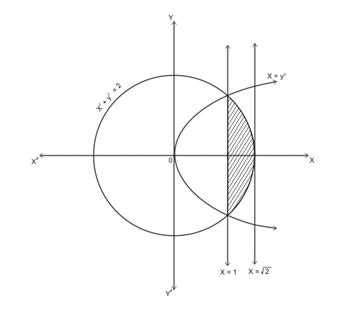
 The area above x axis is bounded between X-axis, curve C2 from (0,1) and curve C1 from(1,
 ) and the total bounded area is symmetric about X-axis so the required area is

Q2. Draw a sketch of the curves y = sin x and y = cos x at  and find the area of the region enclosed by them and X-axis.
and find the area of the region enclosed by them and X-axis.Solution
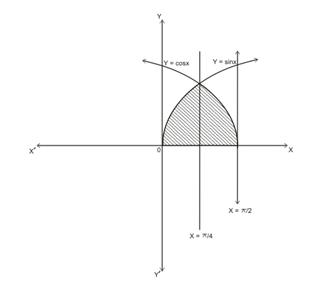
 The region is divided into two parts, one from x = 0 to
  and second from to x =
  .But the region is symmetric about x=∏/4 so the required area is

 The required area is 2-
Q3. Find the area between the curves  .
.
.Solution


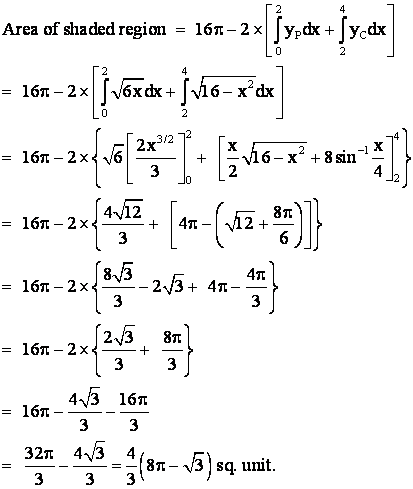
Q4. Find the area of the circle  exterior to the parabola
  .
.
exterior to the parabola .Solution
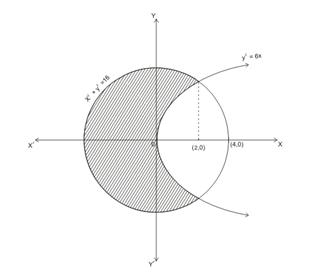
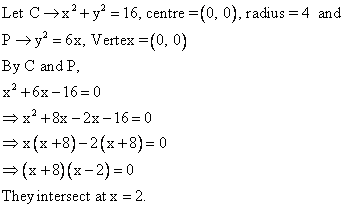
Q5. Find the area bounded by the curve  and X-axis.
and X-axis.Solution
The region bounded by two parallel lines x = 1 and x = 3.
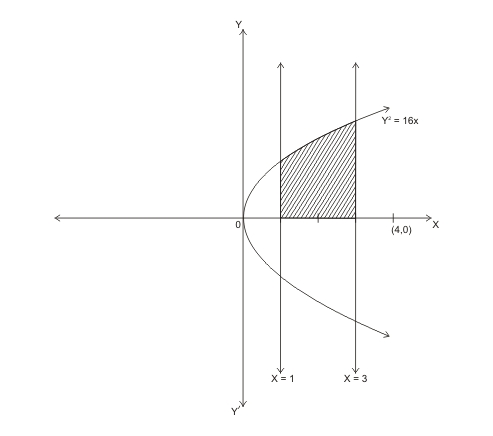 Required area =

Required area =
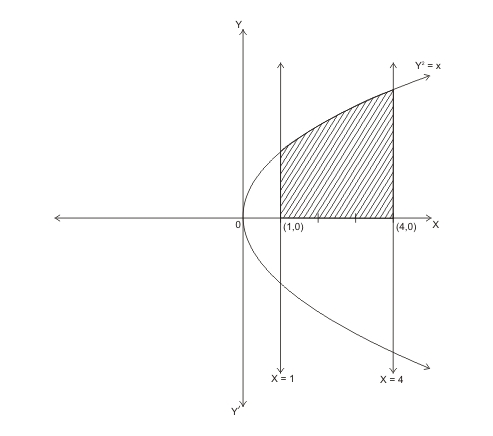
Q6. Find the area of region bounded by  , x = 1, x = 4 and the X-axis.
, x = 1, x = 4 and the X-axis.Solution

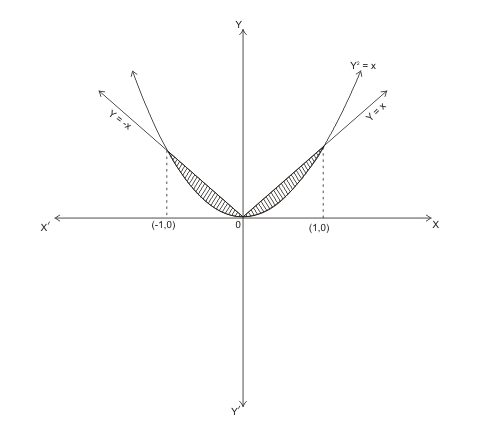
Q7. Find the area of region bounded by  and
and  .
.
and .Solution

Q8. Using integration, find the area bounded by the curve  .
.
.Solution


Q9. Find the area of region bounded by  and
and  using integration.
and using integration.Solution
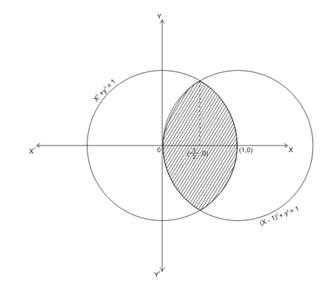
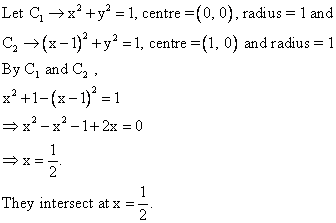
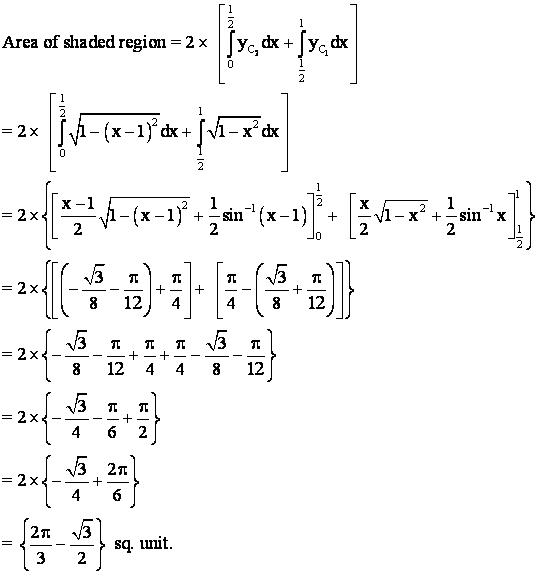
Q10. Find the area enclosed by the curve  , x = 6, x = 9 and X-axis.
, x = 6, x = 9 and X-axis.Solution
The curve , x = 6, x = 9.
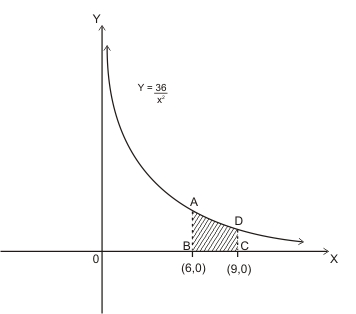 Required area =
 .
.
, x = 6, x = 9.
Required area =.
Comments
Post a Comment