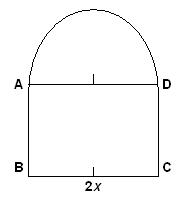
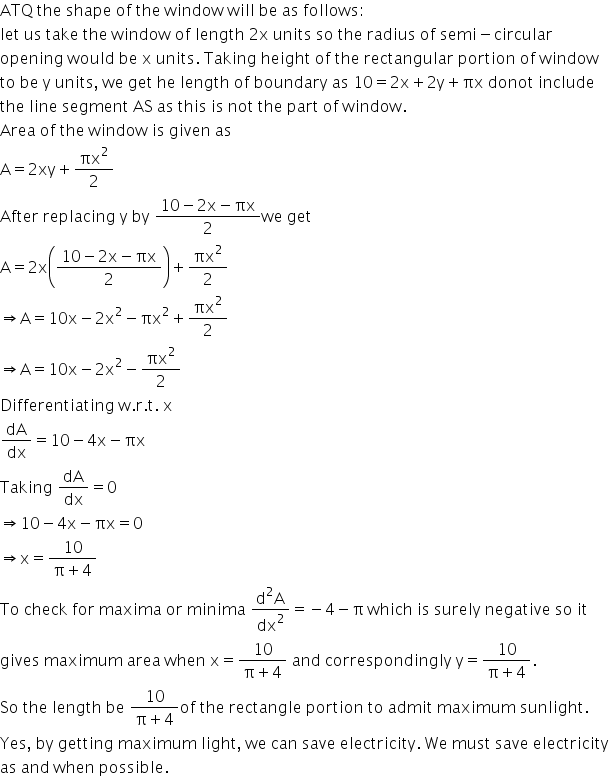
Q1. A window is in the form of a rectangle surmounted by a semi circular opening. The total perimeter of the window is 10 m. Find the dimensions o the window to admit maximum light through the whole opening. Do you think that by getting maximum light, we can save electricity? Do you agree that we should save electricity?
Solution
Q2. Find the points at which the f given f (x) = ( x –2)4 (x + 1)3 has local maxima
Solution
We have,
f (x) = (x – 2)4 (x + 1)3

 = 4 (x – 2)3 (x + 1)3 + 3 (x – 2)4 (x + 1)2
= (x – 2)3 (x + 1)2 (7x – 2)
= (x – 2)2 (x + 1)2(x – 2) (7x – 2)
Now,
= 0 x =
= 4 (x – 2)3 (x + 1)3 + 3 (x – 2)4 (x + 1)2
= (x – 2)3 (x + 1)2 (7x – 2)
= (x – 2)2 (x + 1)2(x – 2) (7x – 2)
Now,
= 0 x =  Since (x – 2)2 (x + 1)2is always positive. So, sign of depends upon the sign of (x – 2) (7x – 2).
Clearly, changes its sign from positive to negative as increases through
Since (x – 2)2 (x + 1)2is always positive. So, sign of depends upon the sign of (x – 2) (7x – 2).
Clearly, changes its sign from positive to negative as increases through  So, x =
  is a point of local maximum.
= 4 (x – 2)3 (x + 1)3 + 3 (x – 2)4 (x + 1)2
= (x – 2)3 (x + 1)2 (7x – 2)
= (x – 2)2 (x + 1)2(x – 2) (7x – 2)
Now,
= 0 x =
Since (x – 2)2 (x + 1)2is always positive. So, sign of depends upon the sign of (x – 2) (7x – 2).
Clearly, changes its sign from positive to negative as increases through
So, x = is a point of local maximum.
Q3. Show that the normal at any point θ to the curve x = a cos θ + aθ sin θ and y = a sin θ - aθ cos θ is at constant distance from origin.
Solution
We first find slope of tangent for this differentiate x and y with respect to θ.
 and
and  So
So  So slope of normal would be negative reciprocal of
  i.e. slope of normal; would be -cot θ
So equation of normal becomes.
i.e. slope of normal; would be -cot θ
So equation of normal becomes.
 on simplification this reduces to
x cos θ + y sin θ = 0
So length of perpendicular from origin to this line is
on simplification this reduces to
x cos θ + y sin θ = 0
So length of perpendicular from origin to this line is
 So normal at point θ is at constant distance from origin for whatever θ you choose.
and
So
So slope of normal would be negative reciprocal of i.e. slope of normal; would be -cot θ
So equation of normal becomes.
on simplification this reduces to
x cos θ + y sin θ = 0
So length of perpendicular from origin to this line is
So normal at point θ is at constant distance from origin for whatever θ you choose.
Q4. If  Then show that
  is strictly increasing.
Then show that is strictly increasing.Solution
Differentiate to get
 On solving this we get
 Clearly
  because x is strictly between 0 and 1, 0 < x < 1
Therefore function is strictly increasing
because x is strictly between 0 and 1, 0 < x < 1
Therefore function is strictly increasing
to get
On solving this we get
Clearly because x is strictly between 0 and 1, 0 < x < 1
Therefore function is strictly increasing
Q5. The slope of the curve 2y2 = ax2 + b at (1, – 1) is – 1. Find a, b
Solution
The equation of the curve is
2y2 = ax2 + b …(i)
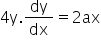
Differentiating w.r.t. x, we get
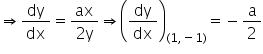 It is given that the slope of the tangent at (1, –1) is –1. Therefore,
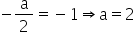 Since the point (1, –1) lies on (i). Therefore,
2 (–1)2 = a (1)2 + b Þ a + b = 2
Putting a = 2 in a + b = 2, we obtain b = 0.
Hence a = 2 and b = 0.
Since the point (1, –1) lies on (i). Therefore,
2 (–1)2 = a (1)2 + b Þ a + b = 2
Putting a = 2 in a + b = 2, we obtain b = 0.
Hence a = 2 and b = 0.
It is given that the slope of the tangent at (1, –1) is –1. Therefore,
Since the point (1, –1) lies on (i). Therefore,
2 (–1)2 = a (1)2 + b Þ a + b = 2
Putting a = 2 in a + b = 2, we obtain b = 0.
Hence a = 2 and b = 0.
Q6. A balloon which is spherical is being inflated by pumping gas in at the rate of 8 cm3/sec. Find the rate at which the surface area increases when the radius is 4cm? On the balloon Make India Polio Free is printed. Do you think that we should work seriously towards Polio eradication?
Solution
 When radius is 4 cm, rate of change of surface area is 4cm2/sec
OR
'Polio eradication' should be our ultimate goal. Because of polio, lives of many children are ruined.
When radius is 4 cm, rate of change of surface area is 4cm2/sec
OR
'Polio eradication' should be our ultimate goal. Because of polio, lives of many children are ruined.
Q7. Find the equation of tangent to the curve y = x3 + 3x2 - 7x - 20 which is perpendicular to x + 2y = 6
Solution
Here are will first find point at which tangent is to be found out.
Slope of line  since tangent is perpendicular to this line so slope of tangent should be negative reciprocal of
  so slope of tangent is 2.
Now differentiating the equation of curve
so slope of tangent is 2.
Now differentiating the equation of curve
 Let (x1, y1) be the point on curve at which we want to find tangent
Therefore slope of tangent at
Let (x1, y1) be the point on curve at which we want to find tangent
Therefore slope of tangent at  3x12 + 6x1 - 7
Now the slope should be 2
Therefore 3x12 + 6x1 - 7 =2
3x12 + 6x1 - 9 = 0
3(x1 + 2x1 - 9) = 0
So 3(x1 + 3)(x1 - 1) = 0
So x1 = -3, x1 = 1
Taking equation of curve y = x3 + 3x2 - 7x - 20
When x1= -3, y1 = (-3)3 + 3(-3)2 - 3 - 20
When x1 = 1, y1 = -23
So pts. are (-3, 1) and (1, -23) and slope is 2 so equations are
y - 1 = 2 (x + 3) i.e. 2x - y + 7 = 0
and y + 23 = 2(x - 1) i.e. 2x - y - 25 = 0
3x12 + 6x1 - 7
Now the slope should be 2
Therefore 3x12 + 6x1 - 7 =2
3x12 + 6x1 - 9 = 0
3(x1 + 2x1 - 9) = 0
So 3(x1 + 3)(x1 - 1) = 0
So x1 = -3, x1 = 1
Taking equation of curve y = x3 + 3x2 - 7x - 20
When x1= -3, y1 = (-3)3 + 3(-3)2 - 3 - 20
When x1 = 1, y1 = -23
So pts. are (-3, 1) and (1, -23) and slope is 2 so equations are
y - 1 = 2 (x + 3) i.e. 2x - y + 7 = 0
and y + 23 = 2(x - 1) i.e. 2x - y - 25 = 0
since tangent is perpendicular to this line so slope of tangent should be negative reciprocal of so slope of tangent is 2.
Now differentiating the equation of curve
Let (x1, y1) be the point on curve at which we want to find tangent
Therefore slope of tangent at
3x12 + 6x1 - 7
Now the slope should be 2
Therefore 3x12 + 6x1 - 7 =2
3x12 + 6x1 - 9 = 0
3(x1 + 2x1 - 9) = 0
So 3(x1 + 3)(x1 - 1) = 0
So x1 = -3, x1 = 1
Taking equation of curve y = x3 + 3x2 - 7x - 20
When x1= -3, y1 = (-3)3 + 3(-3)2 - 3 - 20
When x1 = 1, y1 = -23
So pts. are (-3, 1) and (1, -23) and slope is 2 so equations are
y - 1 = 2 (x + 3) i.e. 2x - y + 7 = 0
and y + 23 = 2(x - 1) i.e. 2x - y - 25 = 0
Q8. Find all the points of local maxima and minima and the corresponding maximum and minimum values of the function f (x) = 
Solution
We have,
f (x) = 

 = – 3x3 – 24x2 – 45x
= –3x (x2 + 8x + 15)
For local maximum or local minimum, we must have
= 0
– 3x (x2 + 8x + 15) = 0
– 3x (x + 3) (x + 5) = 0 x = 0, –3, –5
Thus, x = 0, x = –3 and x = –5 are the possible points of local maxima or minima.
For x=0, f'(x) changes from positive to negative. So x=0 is the point of local maxima.
For x=-3, f'(x) changes its sign from negative to positive. So x=-3 is a point of local minima.
For x=-5, f'(x) changes sign from positive to negative. So x=-5 is a point of local maxima.
Corresponding values of f(x), we get
x=0, f(x) = 105
x=-3, f(x) = 57.75
x=-5, f(x) = 73.75
= – 3x3 – 24x2 – 45x
= –3x (x2 + 8x + 15)
For local maximum or local minimum, we must have
= 0
– 3x (x2 + 8x + 15) = 0
– 3x (x + 3) (x + 5) = 0 x = 0, –3, –5
Thus, x = 0, x = –3 and x = –5 are the possible points of local maxima or minima.
For x=0, f'(x) changes from positive to negative. So x=0 is the point of local maxima.
For x=-3, f'(x) changes its sign from negative to positive. So x=-3 is a point of local minima.
For x=-5, f'(x) changes sign from positive to negative. So x=-5 is a point of local maxima.
Corresponding values of f(x), we get
x=0, f(x) = 105
x=-3, f(x) = 57.75
x=-5, f(x) = 73.75
= – 3x3 – 24x2 – 45x
= –3x (x2 + 8x + 15)
For local maximum or local minimum, we must have
= 0
– 3x (x2 + 8x + 15) = 0
– 3x (x + 3) (x + 5) = 0 x = 0, –3, –5
Thus, x = 0, x = –3 and x = –5 are the possible points of local maxima or minima.
For x=0, f'(x) changes from positive to negative. So x=0 is the point of local maxima.
For x=-3, f'(x) changes its sign from negative to positive. So x=-3 is a point of local minima.
For x=-5, f'(x) changes sign from positive to negative. So x=-5 is a point of local maxima.
Corresponding values of f(x), we get
x=0, f(x) = 105
x=-3, f(x) = 57.75
x=-5, f(x) = 73.75
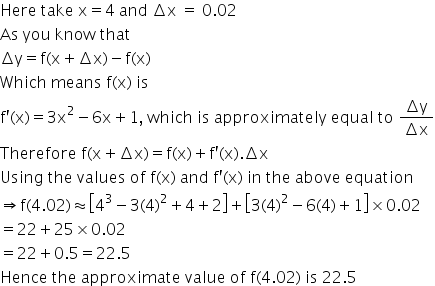
Q9. Find the approximate value of f(4.02) where the function is given by
f(x)=x3 - 3x2 + x + 2
Solution
Q10. Show that the height of cylinder of greatest volume which can be inscribed in a right circular cone of height h and semi vertical angle x is one third that of the cone and the greatest volume of cylinder is 
Solution


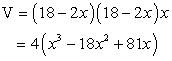
Q11. A square piece of tin of side 18 cm is to made into a box without top by cutting a square from each corner and folding up the flaps to form a box. What should be the side of the square to be cut off so that the volume of the box is maximum. On four sides of this box, write four life skills.
Solution
Let x cm be the length of each side of the square which should be cut off from corners of the square tin sheet.
Let V be the volume of the open box
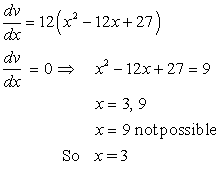
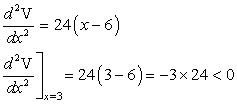 So Volume is maximum when x=3
So volume is maximum when the side of the square to be cut off is 3 cm.
Four life skills: Responsible, polite, love for peace, spirit of brotherhood
So Volume is maximum when x=3
So volume is maximum when the side of the square to be cut off is 3 cm.
Four life skills: Responsible, polite, love for peace, spirit of brotherhood
So Volume is maximum when x=3
So volume is maximum when the side of the square to be cut off is 3 cm.
Four life skills: Responsible, polite, love for peace, spirit of brotherhood
Q12. Find absolute maxima or absolute minima for the following function in the given interval 
Solution
Let us take the function
 As before to locate the points of local maxima or minima we differentiate this function with respect to
  .
.
 Taking
  Which implies
  Which
Which  Let us now evaluate values of given function at these extreme points as well as boundary points.
 Comparing these results we see absolute maximum value is
  at
at  and absolute minimum value is
  at
at Note that
 changes sign from negative to positive as passes through so it is also a point of local minima so here points of absolute maximum or minimum values are also the points of local maxima or minima.
As before to locate the points of local maxima or minima we differentiate this function with respect to .
Taking
Which implies
Which
Let us now evaluate values of given function at these extreme points as well as boundary points.
Comparing these results we see absolute maximum value is at and absolute minimum value is at
Note thatchanges sign from negative to positive as passes through so it is also a point of local minima so here points of absolute maximum or minimum values are also the points of local maxima or minima.
Q13. Prove that the curves x = y2 and xy = k cut at right angles if 8k2 = 1.
Solution
As before let us first find the point of intersection of curves.
y2.y = k means y = k1/3 So x = k2/3
therefore point of intersection of curves is (k2/3 , k1/3 )
differentiating x = y2 with respect to x
we get  So slope of tangent to this curve at (k2/3 , k1/3 ) is
  Similarly differentiating xy = k with respect to x
 So slope of tangent to curve xy = k at (k2/3 , k1/3 ) is
 If these curves intersect at right angles then m1m2 = -1
So
If these curves intersect at right angles then m1m2 = -1
So  Which gives 1 = 2k2/3. Taking cubes we get the condition 8k2 = 1
So slope of tangent to this curve at (k2/3 , k1/3 ) is
Similarly differentiating xy = k with respect to x
So slope of tangent to curve xy = k at (k2/3 , k1/3 ) is
If these curves intersect at right angles then m1m2 = -1
So
Which gives 1 = 2k2/3. Taking cubes we get the condition 8k2 = 1
Q14. Find the angle of intersection of the curves x2 = y and y2 = x
Solution
We first need to find their points of intersection. So solving these equations of curves we get x4 = x
Which gives x = 0, x = 1
Therefore points of intersection of the curves are (0, 0), (1, 1)
Differentiating  with respect to x we get
  Similarly differentiating
  we get
 which gives
  To find angle of intersection at (0, 0)
So m1 = slope of tangent to curve x2 = y at (0,0)
= 2x ](0,0) = 0 So tangent is parallel to
To find angle of intersection at (0, 0)
So m1 = slope of tangent to curve x2 = y at (0,0)
= 2x ](0,0) = 0 So tangent is parallel to  axis
m2= slope of tangent to curve y2 = x at (0,0)
axis
m2= slope of tangent to curve y2 = x at (0,0)
 = not defined
So tangent is parallel to y axis
Now one tangent is parallel to x axis and other is parallel to y axis. So angle between tangents is right angle. So we can say curves intersect orthoganally at (0, 0)
Similarly to find angle between curves at (1, 1)
m1 = slope of tangent to curve x2 = y at (1,1)
= 2
m2 = Slope of tangent to curve x = y 2 at (1,1)
= not defined
So tangent is parallel to y axis
Now one tangent is parallel to x axis and other is parallel to y axis. So angle between tangents is right angle. So we can say curves intersect orthoganally at (0, 0)
Similarly to find angle between curves at (1, 1)
m1 = slope of tangent to curve x2 = y at (1,1)
= 2
m2 = Slope of tangent to curve x = y 2 at (1,1)
 If θ is the angle of intersection of curves then
 So θ is given by tan θ = 3/4
with respect to x we get
Similarly differentiating we get
which gives
To find angle of intersection at (0, 0)
So m1 = slope of tangent to curve x2 = y at (0,0)
= 2x ](0,0) = 0 So tangent is parallel to axis
m2= slope of tangent to curve y2 = x at (0,0)
= not defined
So tangent is parallel to y axis
Now one tangent is parallel to x axis and other is parallel to y axis. So angle between tangents is right angle. So we can say curves intersect orthoganally at (0, 0)
Similarly to find angle between curves at (1, 1)
m1 = slope of tangent to curve x2 = y at (1,1)
= 2
m2 = Slope of tangent to curve x = y 2 at (1,1)
If θ is the angle of intersection of curves then
So θ is given by tan θ = 3/4
Q15. Show that f (x) = tan-1 (sin x + cos x) is an increasing function on the interval 
Solution

Q16. Find the equation of tangent to the curve y = cos (x + y), 0 < x < ∏ which is perpendicular to 2x - y = 7
Solution
Differentiating y = cos(x + y) with respect to x we get
 So
So  Let (x1, y1) be any point on the curve so slope of tangent at (x1, y1) is given by
 Also slope of given line is 2 and tangent required is perpendicular to this line so slope of tangent would be
  Therefore
  So
So  Therefore on solving we get
sin (x1 + y1) = 1
So
Therefore on solving we get
sin (x1 + y1) = 1
So  where n is an integer
For this value of x + y,
But
where n is an integer
For this value of x + y,
But  = 0 for all integral values of n
So y is always zero.
And since 0 < x <
= 0 for all integral values of n
So y is always zero.
And since 0 < x <  we must have
 So
So  So coordinates of pts on the curve where we want to find tangent is
  So equation of tangent becomes
 or 2x + 4y = is the required tangent.
So
Let (x1, y1) be any point on the curve so slope of tangent at (x1, y1) is given by
Also slope of given line is 2 and tangent required is perpendicular to this line so slope of tangent would be
Therefore
So
Therefore on solving we get
sin (x1 + y1) = 1
So where n is an integer
For this value of x + y,
But
= 0 for all integral values of n
So y is always zero.
And since 0 < x < we must have
So
So coordinates of pts on the curve where we want to find tangent is
So equation of tangent becomes
or 2x + 4y = is the required tangent.
Q17. Find the intervals in which the function f (x) = 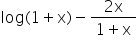 is increasing or decreasing
is increasing or decreasingSolution
We have,
f (x) =
Clearly, f (x) is defined for all x satisfying
x + 1 > 0 i.e. x > – 1
So, domain (f) = (–1, ¥)
Now,
f (x) =
Þ f ¢ (x) =  Þ f ¢ (x) =
 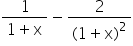 Þ f ¢ (x) =
 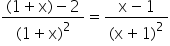 For f (x) is be increasing, we must have
f¢ (x) > 0
Þ
For f (x) is be increasing, we must have
f¢ (x) > 0
Þ 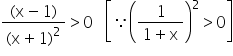 Þ x - 1 > 0
Þ x > 1
Þ x Î (1, ¥)
So, f (x) is increasing on (1, ¥)
Hence, f (x) is increasing in its domain
Þ x - 1 > 0
Þ x > 1
Þ x Î (1, ¥)
So, f (x) is increasing on (1, ¥)
Hence, f (x) is increasing in its domain
Clearly, f (x) is defined for all x satisfying
x + 1 > 0 i.e. x > – 1
So, domain (f) = (–1, ¥)
Now,
f (x) =
Þ f ¢ (x) =
Þ f ¢ (x) =
Þ f ¢ (x) =
For f (x) is be increasing, we must have
f¢ (x) > 0
Þ
Þ x - 1 > 0
Þ x > 1
Þ x Î (1, ¥)
So, f (x) is increasing on (1, ¥)
Hence, f (x) is increasing in its domain
Q18. Evaluate 
Solution
Take x=4 and Δx=0.01
Note here that we have taken  as 4 as its square root exists.
 Which means
  Now,
Now,
 Therefore,
 Hence,

as 4 as its square root exists.
Which means
Now,
Therefore,
Hence,
Q19. Find the equation of the normal to the curve y = (1 + x)y + sin–1 (sin2 x) at x = 0.
Solution
We have,
y = (1 + x)y + sin–1 (sin2 x) …(i) Putting x = 0, we get
y = (1 + 0)y + sin–1 (sin2 0)
Þ y = 1
Thus, we have to write the equation of the normal to (i) at P (0, 1).
Differentiating (i) w.r.t. x, we get
 Putting x = 0 and y = 1, we obtain
 Hence, the equation of the normal at P (0, 1) is
y – 1 = – 1 (x – 0)
or x + y= 1
Hence, the equation of the normal at P (0, 1) is
y – 1 = – 1 (x – 0)
or x + y= 1
Putting x = 0 and y = 1, we obtain
Hence, the equation of the normal at P (0, 1) is
y – 1 = – 1 (x – 0)
or x + y= 1
Q20. Look at the conical funnel whose vertical angle is 90o. Water is dripping out from it at uniformly at the rate of 8 cm3/sec through a tiny hole at the vertex. Find the rate at which the slant height of the water is decreasing when the slant height of the water is 4cm.
Is leaking of water leads to wastage of water? Do you think we can afford to waste our natural resources?
Solution
Let V be the volume of the Water at time 't'.
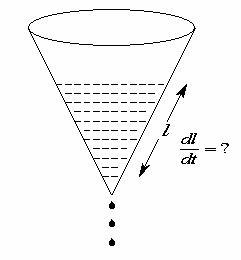 Then,
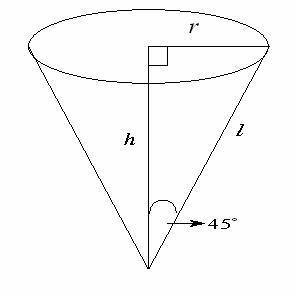
Then, where 'r' and 'h' are the radius and height respectively. From the figure it is clear
 Therefore the volume is
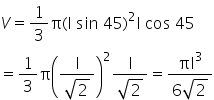

 Differentiating with respect to t we get
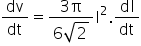 Now we are given
 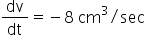 Therefore,
 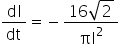 When the slant height is 4cm
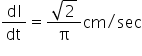 Slant height is decreasing at the rate of
 Yes, leaking of water leads to wastage of water. We must do everything possible to save our natural resources.
Then, where 'r' and 'h' are the radius and height respectively. From the figure it is clear
Therefore the volume is
Differentiating with respect to t we get
Now we are given
Therefore,
When the slant height is 4cm
Slant height is decreasing at the rate of
Yes, leaking of water leads to wastage of water. We must do everything possible to save our natural resources.
Q21. Find the intervals in which the function f (x) is increasing, f (x) = 2x3 - 9x2 + 12x + 15
Solution
We have,
f (x) = 2x3 - 9x2 + 12x + 15
& f (x) = 6x2 - 18x + 12 = 6(x2 - 3x + 2)
(i) For f (x) to be increasing, we must have
f'(x) > 0
=> 6 (x2 - 3x + 2) > 0
=> x2 - 3x + 2 > 0 [ 6 > 0 \ 6(x2 - 3x + 2) > 0 & x2 - 3x + 2 > 0)
=> (x - 1) (x - 2) > 0
=> x < 1 or x > 2
(¥, 1)υ(2, ¥)
So, f(x) is increasing on (¥, 1)υ(2, ¥)
6 > 0 \ 6(x2 - 3x + 2) > 0 & x2 - 3x + 2 > 0)
=> (x - 1) (x - 2) > 0
=> x < 1 or x > 2
(¥, 1)υ(2, ¥)
So, f(x) is increasing on (¥, 1)υ(2, ¥)
6 > 0 \ 6(x2 - 3x + 2) > 0 & x2 - 3x + 2 > 0)
=> (x - 1) (x - 2) > 0
=> x < 1 or x > 2
(¥, 1)υ(2, ¥)
So, f(x) is increasing on (¥, 1)υ(2, ¥)
Q22. Show that the following function is neither strictly increasing nor strictly decreasing in 
Solution
Differentiating the function we get
 Equate
  to zero to get
  .
So
.
So  divides the real line into disjoint intervals
  In the interval , cot x is greater than 1
So cot x - 1 is negative
Therefore f'(x) is negative and the function is strictly decreasing in .
Similarly, cot x is less than 1 in
In the interval , cot x is greater than 1
So cot x - 1 is negative
Therefore f'(x) is negative and the function is strictly decreasing in .
Similarly, cot x is less than 1 in  So cot x -1 is positive.
Therefore f'(x) is positive and the function is strictly increasing in .
So overall in the interval
So cot x -1 is positive.
Therefore f'(x) is positive and the function is strictly increasing in .
So overall in the interval  , the function is neither increasing nor decreasing.
Equate to zero to get .
So divides the real line into disjoint intervals
In the interval , cot x is greater than 1
So cot x - 1 is negative
Therefore f'(x) is negative and the function is strictly decreasing in .
Similarly, cot x is less than 1 in
So cot x -1 is positive.
Therefore f'(x) is positive and the function is strictly increasing in .
So overall in the interval , the function is neither increasing nor decreasing.
Q23. Separate  into subintervals in which f (x) = sin 3x is increasing or decreasing
into subintervals in which f (x) = sin 3x is increasing or decreasing Solution
We have,
f (x) = sin 3x
Þ f ¢ (x) = 3 cos 3x
Now,  or
or  Since cosine function is positive in first quadrant and negative in the second and third quadrants. Therefore, we consider the following cases
Case I : When
In this case, we have
Þ cos 3x > 0 Þ 3 cos 3x > 0 Þ f ¢ (x) > 0
Thus, f ¢ (x) > 0 for i.e.,
Since cosine function is positive in first quadrant and negative in the second and third quadrants. Therefore, we consider the following cases
Case I : When
In this case, we have
Þ cos 3x > 0 Þ 3 cos 3x > 0 Þ f ¢ (x) > 0
Thus, f ¢ (x) > 0 for i.e.,  So, f (x) is increasing on
  Case II : When
  In this case, we have
Þ cos 3x < 0 Þ 3 cos 3x < 0 Þ f ¢ (x) < 0
Thus, f ¢ (x) < 0 for i.e.,
In this case, we have
Þ cos 3x < 0 Þ 3 cos 3x < 0 Þ f ¢ (x) < 0
Thus, f ¢ (x) < 0 for i.e.,  So, f (x) is decreasing on
  Hence, f (x) is increasing on and decreasing on
or
Since cosine function is positive in first quadrant and negative in the second and third quadrants. Therefore, we consider the following cases
Case I : When
In this case, we have
Þ cos 3x > 0 Þ 3 cos 3x > 0 Þ f ¢ (x) > 0
Thus, f ¢ (x) > 0 for i.e.,
So, f (x) is increasing on
Case II : When
In this case, we have
Þ cos 3x < 0 Þ 3 cos 3x < 0 Þ f ¢ (x) < 0
Thus, f ¢ (x) < 0 for i.e.,
So, f (x) is decreasing on
Hence, f (x) is increasing on and decreasing on
Comments
Post a Comment