Q1. Show that the vectors  and
and  are coplanar
and are coplanarSolution
The vectors are coplanar, if
  = 0
= 0

are coplanar, if = 0
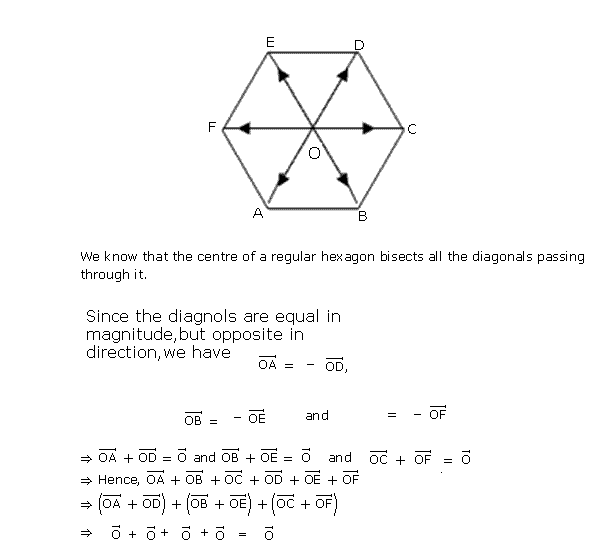
Q2. 
Solution
Q3. Find the scalar product of the vectors  and
and  .
.
and .Solution
Let  and
and 

and
Q4. Find the scalar projection of the vector  on the vector
  .
.
on the vector .Solution
Scalar projection  on
on 

on
Q5. Write the direction ratio’s of the vector  and hence calculate its direction cosines.
and hence calculate its direction cosines.Solution
The direction ratios of the vector are 1, 2, – 3 and
 .
.
are 1, 2, – 3 and
.
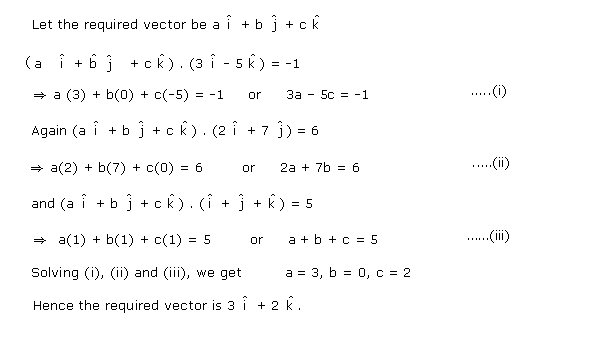
Q6. 
Solution
Q7. Prove sine formula using vectors, 
Solution
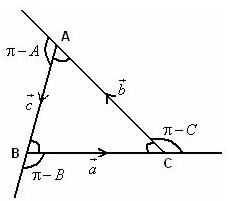
Let ABC be a triangle, such that are the vectors opposite to the angles
 respectively.
 Similarly, we can find
  By using equations (1) and (2), we get

are the vectors opposite to the angles respectively.
Similarly, we can find
By using equations (1) and (2), we get
Q8. If  are unit vector such that
 then find the value of
 .
.
are unit vector such that then find the value of.Solution
Here, we have 

Q9. 
Solution

Q10. If and
and . Find the angle between
 .
.
and. Find the angle between.Solution
Here, we have
 Squaring on both sides, we get
 Let
Let be the angle between the vectors.
 Thus, the angle between is 60°.
Squaring on both sides, we get
Let be the angle between the vectors.
Thus, the angle between is 60°.
Q11. Find the position vector of a point R which divides the line joining two points P and Q whose position vectors are  respectively, in the ratio 2 : 3 internally.
respectively, in the ratio 2 : 3 internally.Solution
Let m=2 and n= 3

Q12. If  and
and  represent two sides of a parallelogram, find unit vector parallel to the diagonals of the parallelogram.
and represent two sides of a parallelogram, find unit vector parallel to the diagonals of the parallelogram.Solution
Let OPQR is a parallelogram such that  and
and  .
.
 {
{ }
}

and .
{}
Q13. Find the value of x & y so that the vectors  are equal.
are equal.Solution
The vectors are equal, if and only if there corresponding components are equal
ie x = 6 and y = 2x
i.e., x = 6 and y = 12.
Q14. Find the angle between the vectors  and
and  .
.
and .Solution
Let  be the angle between the vectors and
 .
.

be the angle between the vectors and.
Q15. If  , then show that
  .
.
, then show that .Solution
Here, we have
 So, by the equations (1) and (2), we get
So, by the equations (1) and (2), we get
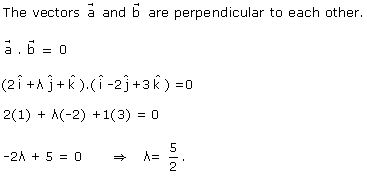
Q16. 
Solution
Q17. Find the unit vector in the direction of  , where A and B are the points (2, – 3, 7) and (1, 3, – 4).
, where A and B are the points (2, – 3, 7) and (1, 3, – 4).Solution

Q18. The vectors  are the diagonal of a parallelogram. What is the area of the parallelogram?
are the diagonal of a parallelogram. What is the area of the parallelogram? Solution
If are the diagonal of a parallelogram, then the area of the parallelogram is  .
.
are the diagonal of a parallelogram, then the area of the parallelogram is .
Q19. The position vectors of A, B and C are  and
and  . Prove that A, B and C are collinear.
and . Prove that A, B and C are collinear.Solution
Here, we have
 Since,
 , therefore
  are parallel, but B is the common point in both the vectors. Thus, A, B and C are collinear.
Since,, therefore are parallel, but B is the common point in both the vectors. Thus, A, B and C are collinear.
Q20. If  , then find the value of
, then find the value of Solution
Here, we have

Q21. Find unit vector in the direction of vector  .
.
.Solution

Q22. 
Solution
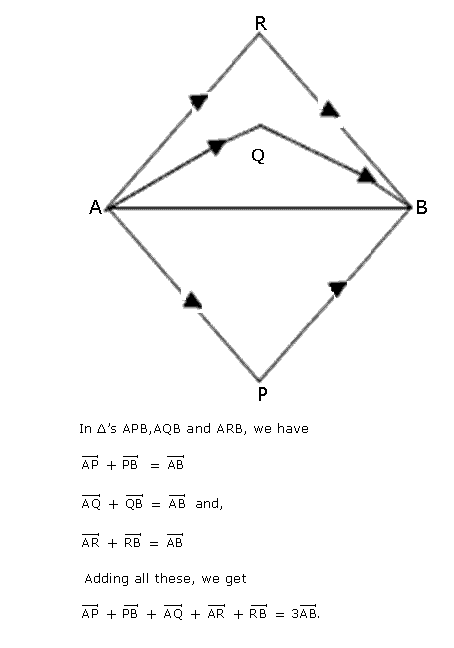
Q23. If  , then find the vector
  , such that
, then find the vector , such that Solution
Here, we have
Let

 On solving the equations, we get

Let
On solving the equations, we get
Comments
Post a Comment