Q1.  defined by f(x) = 2x, g(y) = 3y + 4 and h(z) = cosz for all x, y, z in N. Show that ho(gof) = (hog)of.
defined by f(x) = 2x, g(y) = 3y + 4 and h(z) = cosz for all x, y, z in N. Show that ho(gof) = (hog)of.Solution
Here, we have f(x) = 2x, g(y) = 3y + 4 and h(z) = cosz for all x, y, z in N.
L.H.S. = ho(gof)(x)
= ho[g(f(x))] = h[gof(x)]
= h(g(f(x))) = h(g(2x))
= h(3(2x) + 4) = h(6x + 4)
= cos (6x + 4)
R.H.S. = (hog)of (x)
= hog(f(x)) = h(g(f(x)))
= h(g(2x)) = h(3(2x) + 4)
= h(6x + 4) = cos(6x + 4)
Hence, ho(gof) = (hog)of.
Q2. For the binary operation * defined by a * b = a + b + 1. Find the identity element for operation *.
Solution
Let e be the identity element for operation * and we know that
a * e = a = e * a.
or a + e + 1 = a and e + a +1 = a
or e = – 1 and e = – 1.
Thus, – 1 is the identity element for operation *.
Q3. Check the function  given by
  is one-one or not.
given by is one-one or not.Solution
 For x = 1, f(1) = 0,
For x = 2, f(2) = 0,
For x = 3, f(3) = 0.
Since f(1) = f(2) = f(3) = 0, therefore f is not one-one.
For x = 1, f(1) = 0,
For x = 2, f(2) = 0,
For x = 3, f(3) = 0.
Since f(1) = f(2) = f(3) = 0, therefore f is not one-one.
Q4. Show that the function  defined by
  is onto function.
defined by is onto function.Solution
 Since f(x) = y, therefore f is onto function.
Q5. If  are defined as f(x) = cos x and g(x) = x2. Show that
  .
.
are defined as f(x) = cos x and g(x) = x2. Show that .Solution
We f(x) = cos x and g(x) = x2.
gof(x) = g(f(x)) = g(cos x) = (cos x)2 = cos2x
and fog(x) = f(g(x)) = f(x2) = cos(x2).
Hence, .
.
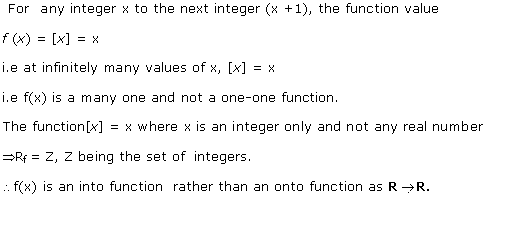
Q6. 
Solution
Q7. Show that the function  defined by
 is one-one and onto.
defined by
is one-one and onto.Solution
(i) f is one-one:
For 
 for x < 0,
 For – 1 < x < 1, lies between
  .
So, f is one-one.
(ii) f is onto:
For
.
So, f is one-one.
(ii) f is onto:
For  For
For  In both cases, each value of y in co-domain of f has a unique value in its domain.
Hence, f is onto.
In both cases, each value of y in co-domain of f has a unique value in its domain.
Hence, f is onto.
for x < 0,
For – 1 < x < 1, lies between .
So, f is one-one.
(ii) f is onto:
For
For
In both cases, each value of y in co-domain of f has a unique value in its domain.
Hence, f is onto.
Q8. Let  be defined by
  Show that the function f is a bijective function.
be defined by
Show that the function f is a bijective function.Solution
Here, be defined by
(a) f is one-one:
 Therefore, f is one-one, i.e. injective.
(b) f is onto:
For every natural number, f has a unique value in co-domain. So, every member of co-domain has a pre-image has a pre-image in its domain. So, f is onto.
f is surjective.
Since f is injective and surjective both, therefore f is a bijective function.
Therefore, f is one-one, i.e. injective.
(b) f is onto:
For every natural number, f has a unique value in co-domain. So, every member of co-domain has a pre-image has a pre-image in its domain. So, f is onto.
f is surjective.
Since f is injective and surjective both, therefore f is a bijective function.
be defined by
(a) f is one-one:
Therefore, f is one-one, i.e. injective.
(b) f is onto:
For every natural number, f has a unique value in co-domain. So, every member of co-domain has a pre-image has a pre-image in its domain. So, f is onto.
f is surjective.
Since f is injective and surjective both, therefore f is a bijective function.
Q9. For the binary operation * defined by a * b = ab/1000. Find the inverse of 0.01.
Solution
Let e be the identity element for operation * and we know that
 Also, let i be the inverse of 0.01, then

Also, let i be the inverse of 0.01, then
Q10. If  show that fof(x) = x for all
  . Also find the inverse of f.
show that fof(x) = x for all . Also find the inverse of f.Solution
We have,


Q11. Show that the modulus function  defined by f(x) = | 2x | is neither one-one nor onto.
defined by f(x) = | 2x | is neither one-one nor onto.Solution
Here, the modulus function defined by  .
If f(1) = 2 and f(– 1) = – (– 2) = 2.
Since, f(1) = f(– 1) = 2, therefore f is not one-one.
No negative values belonging to co-domain of f has any pre-image in its domain. So, f is not onto function.
.
If f(1) = 2 and f(– 1) = – (– 2) = 2.
Since, f(1) = f(– 1) = 2, therefore f is not one-one.
No negative values belonging to co-domain of f has any pre-image in its domain. So, f is not onto function.
defined by .
If f(1) = 2 and f(– 1) = – (– 2) = 2.
Since, f(1) = f(– 1) = 2, therefore f is not one-one.
No negative values belonging to co-domain of f has any pre-image in its domain. So, f is not onto function.
Q12. Show the relation R in the set
 is an equivalence relation.
is an equivalence relation.Solution
Set A = {0,1, 2, 3, 4, 5, ....,10} and
 or R = {(0, 3), (3, 0), (0, 6), (6, 0), (0, 9), (9, 0), (1, 4), (4, 1),(2, 5), (5, 2), (3, 6), (6, 3), (3, 9),(9, 3),(4, 7), (7, 4),(4, 10), (10, 4), (1, 7), (7, 1),(1, 10), (10, 1), (2, 8), (8, 2),(5, 8), (8, 5),(6, 9), (9, 6),(7, 10), (10, 7), (1, 1), (2, 2), (3, 3), (4, 4), (5, 5), (6, 6), (7, 7), (8, 8), (9, 9), (10, 10)}
(i) a - a = 0 = 3k, where k = 0,
or R = {(0, 3), (3, 0), (0, 6), (6, 0), (0, 9), (9, 0), (1, 4), (4, 1),(2, 5), (5, 2), (3, 6), (6, 3), (3, 9),(9, 3),(4, 7), (7, 4),(4, 10), (10, 4), (1, 7), (7, 1),(1, 10), (10, 1), (2, 8), (8, 2),(5, 8), (8, 5),(6, 9), (9, 6),(7, 10), (10, 7), (1, 1), (2, 2), (3, 3), (4, 4), (5, 5), (6, 6), (7, 7), (8, 8), (9, 9), (10, 10)}
(i) a - a = 0 = 3k, where k = 0,  . So, R is reflexive.
(ii) Here,
. So, R is reflexive.
(ii) Here,  So, R is symmetric.
(iii) Here,
So, R is symmetric.
(iii) Here, 
 So, the relation R is also transitive.
Since, relation R is reflexive, symmetric and transitive, therefore the R is an equivalence relation.
So, the relation R is also transitive.
Since, relation R is reflexive, symmetric and transitive, therefore the R is an equivalence relation.
or R = {(0, 3), (3, 0), (0, 6), (6, 0), (0, 9), (9, 0), (1, 4), (4, 1),(2, 5), (5, 2), (3, 6), (6, 3), (3, 9),(9, 3),(4, 7), (7, 4),(4, 10), (10, 4), (1, 7), (7, 1),(1, 10), (10, 1), (2, 8), (8, 2),(5, 8), (8, 5),(6, 9), (9, 6),(7, 10), (10, 7), (1, 1), (2, 2), (3, 3), (4, 4), (5, 5), (6, 6), (7, 7), (8, 8), (9, 9), (10, 10)}
(i) a - a = 0 = 3k, where k = 0, . So, R is reflexive.
(ii) Here,
So, R is symmetric.
(iii) Here,
So, the relation R is also transitive.
Since, relation R is reflexive, symmetric and transitive, therefore the R is an equivalence relation.
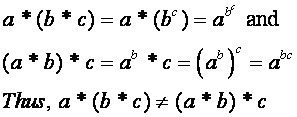
Q13. A binary operation defined by a * b = ab. Is the binary operation associative?
Solution
No.
Here, a * b = ab.
Q14. If P = {5, 6} and Q = {1, 6, 7}, then find P x Q and Q x P.
Solution
P x Q = {(5, 1), (5, 6), (5, 7), (6, 1), (6, 6), (6, 7)} and
Q x P = {(1, 5), (1, 6), (6, 5), (6, 6), (7, 5), (7, 6)}
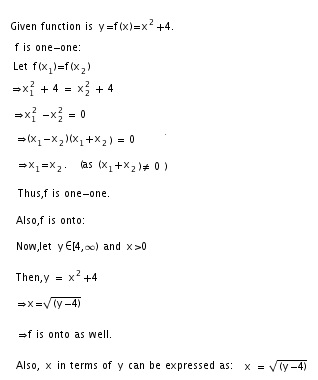
Q15. 
Solution
Q16. If L is the set of all lines in the plane and R is the relation in L defined by R = {(l1, l2) : l1 is parallel to l2}. Show that the relation R is equivalence relation.
Solution
Here, L is the set of all lines in the plane and R = {(l1, l2) : l1 is parallel to l2}.
(i) Every line in a plane is always parallel to itself, i.e., l1 || l2. So, relation R is reflexive.
(ii) If a line l1 is parallel to line l2, then l2 is also parallel to l1.
 . So, R is symmetric.
(iii) If a line l1 is parallel to line l2 and l2 is parallel to l3, then l1 is also parallel to l3.
. So, R is symmetric.
(iii) If a line l1 is parallel to line l2 and l2 is parallel to l3, then l1 is also parallel to l3.
 . So, R is transitive.
Since, relation R is reflexive, symmetric and transitive, therefore the R is an equivalence relation.
. So, R is transitive.
Since, relation R is reflexive, symmetric and transitive, therefore the R is an equivalence relation.
. So, R is symmetric.
(iii) If a line l1 is parallel to line l2 and l2 is parallel to l3, then l1 is also parallel to l3.
. So, R is transitive.
Since, relation R is reflexive, symmetric and transitive, therefore the R is an equivalence relation.
Q17. If  is defined as f(x) = x3 – 2. Find f–1(62).
is defined as f(x) = x3 – 2. Find f–1(62).Solution
We have f(x) = x3 – 2.

Q18. 
Solution

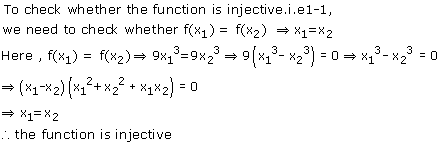
Q19. 
Solution
Comments
Post a Comment